PROJECT OVERVIEW
Support Your Local Shepherd
A Field Guide for Becoming the Kind of Flock a Shepherd Can Lead
Most churches don't fail their pastor on purpose. They fail him the way a potluck fails: everyone assumes somebody else brought the dish, and nobody notices the table's bare until the meal's already started.
They clap on Pastor Appreciation Sunday. They say "we're praying for you" and mean it, right up until the follow-through comes due. They drop off a casserole in a crisis and vanish before the next one hits.
That's not support. That's decency with a side of green beans.
Support Your Local Shepherd lives in the gap between meaning well and doing good, the exact gap where pastors burn out.
Most churches don't reject their shepherd. They just stop noticing him: a thousand small cuts of unspoken expectation, sideways criticism, quiet disengagement, and "sharing concerns" that never becomes an actual conversation.
Leave a man carrying that alone long enough, and the flock doesn't get safer. It scatters.
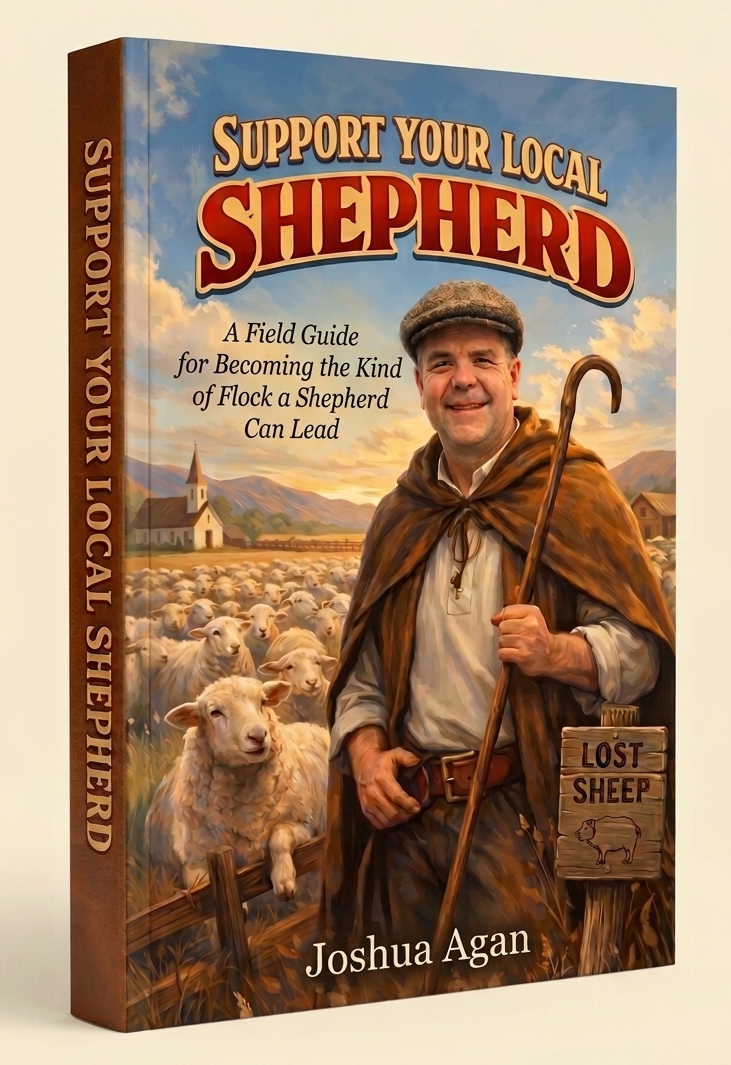
This book is part pastor's-kid memoir, part portrait of a faithful man (my dad), part biblical case for what a shepherd actually is and isn't, and part field guide for the ordinary church member who wants to help without turning it into sentiment, performance, or a once-a-year ovation.
Inside: fence-line stories from three generations of ministry, wolf-sign diagnostics, burden-sharing patterns, and ways to help that outlast the holiday:
- How to give feedback without fog
- How to disagree without dividing
- How to protect rest without guilt
- How to turn "we should support our pastor" into something you can actually schedule
The question was never whether your church has problems. Every church does.
The question is whether yours is becoming the kind of flock a shepherd can actually lead.
(Linked as I write and publish each chapter — file names follow a Part.n scheme; non-content files are grouped separately with an underscore prefix)
- Foreword
- Introduction
— What 'shepherd' and 'support' really mean, and why it matters.
Part I – The Shepherd (and the family behind him)
Defines the shepherd biblically before asking anyone to support him, then humanizes the man behind the pulpit without a pedestal or pity—showing the weight he carries, the limits he faces, the loneliness he endures, and the cost his family absorbs.
- Neither Lord Nor Hireling (ch. 1)
— Because the office matters before the support does. - Dusty Shoes, Real Limits (ch. 2)
— Because faithful men still get tired, lonely, and discouraged—and churches often mistake usefulness for inexhaustibility. - When the Flock Sleeps, He Still Serves (ch. 3)
— So the unseen labor doesn't stay invisible. - All Those Hats, All That Weight (ch. 4)
— And role confusion turns calling into overload. - You Can’t Shepherd Without Boundaries (ch. 5)
— So rest, family, and limits protect the flock—not betray it. - Sheep Bite, and It Hurts (ch. 6)
— And criticism doesn't stop at the office; it follows him home.
Part II – Wolves, Weather, and Worn-Down Fields
Reveals the hidden dynamics, dysfunctional patterns, and quiet church habits that slowly exhaust pastors—not only through obvious conflict, but through systems, expectations, and overgrazing that wear down the shepherd and thin the field beneath him.
- Together, We Share the Burden (ch. 7)
— Because ministry was never meant to be a one-man show. - On Purpose, Not by Accident (ch. 8)
— Because support doesn’t “just happen”; it’s practiced and repeated. - Hands to the Work, Not the Keyboard (ch. 9)
— So shoulder-to-shoulder serving replaces distance critique.
Part III – The Field Guide
Turns insight into action with concrete, repeatable ways to make support more than sentiment—and shepherding sustainable.
- Encouragement Is Fuel (ch. 10)
— And specific gratitude keeps the right fire burning. - Lift His Arms, Don’t Add Weight (ch. 11)
— By building rhythms of help that outlast a holiday. - Practical Help, Week After Week (ch. 12)
— Until your church becomes the kind of flock a shepherd can lead.