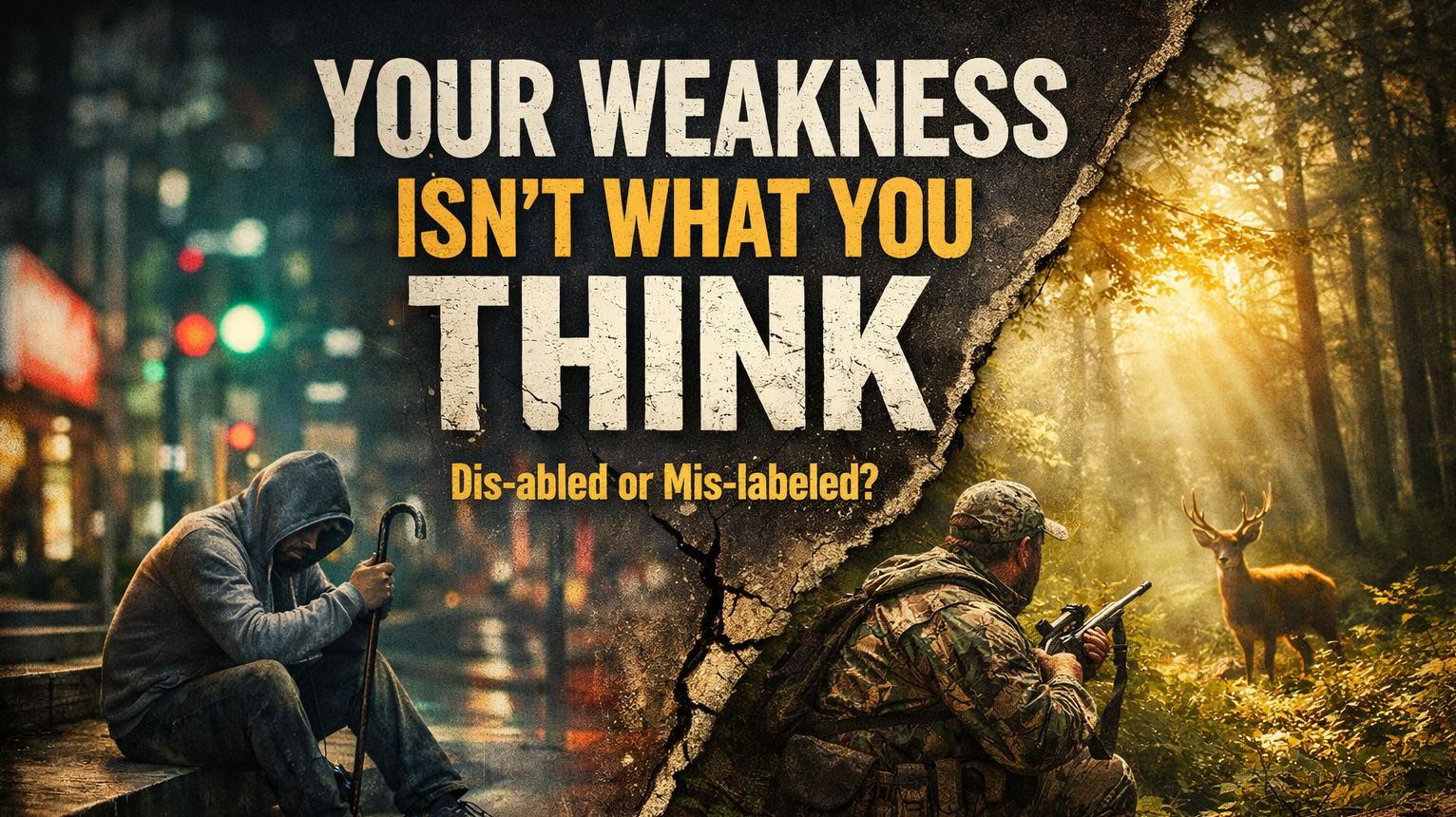
Your Weakness Is Not What You Think
Dis-Abled or Mis-Labeled?
You may have spent years grieving something God never once called useless.
Years apologizing for it.
Years hiding it.
Years asking Him to remove the very thing He meant to consecrate.
The world is quick to call a thing broken when it does not serve its systems well.
It can train you to despise the place where God intends to reveal His strength.
Which means some of what we call brokenness may not be brokenness at all.
The enemy wants to turn you from a human being into a human doing—to shrink your identity down to what you produce, what you perform, what you lack.
That is why God says, I AM.
And Satan says, I will.
One speaks from being.
One speaks from doing.
And that same distortion shapes how we see weakness.
The world sees a limitation in what you can do and calls it a verdict.
God sees the same thing and gives it a purpose.
Take color blindness.
In a concrete jungle of bright branding, traffic signals, screens, and neon, it gets labeled a disability. But in the woods, in the brush, in the broken textures of creation, that same person can spot what "normal" eyes miss completely. In many cases, up to 40 shades that we can't distinguish.
Why?
Because their eyes read contrast differently. They can distinguish subtle variations that others overlook.
So was the ability missing?
Or was it simply misread by the wrong environment?
It is not dis-abled.
It is mis-labeled.
We call people broken because they do not fit the environment.
We call them deficient because their strength does not look familiar.
We assume a lack when, in fact, we are seeing a mismatch.
But this goes deeper than biology.
Jacob limped away from his encounter with God.
By every human measure, that looks like damage.
But that limp came wrapped in something else: a new name, a new identity, and the mark of a life changed by God.
God did not give Jacob bigger muscles than Esau.
He did not make him a better fighter.
He made him cripplingly dependent.
He marked him.
And then Esau—the dangerous brother approaching with hundreds of armed men—saw Jacob limping toward him.
And he wept.
The very thing that looked like weakness walked into a war zone and received mercy.
Recall when Jesus was asked about the man born blind.
Not made blind.
Born blind.
His whole life had become a theological argument for other people.
Who sinned? Who failed? Who caused this?
Jesus refused the blame game.
He answered with purpose:
"That the works of God should be made manifest in him."
Not wasted.
Not random.
Not abandoned.
Positioned.
Fanny Crosby once said that if she had been offered natural sight in this life, she would not have taken it.
Why?
Because the first face she would ever see would be the face of Jesus.
That is not shallow optimism.
That is surrender so deep that what others called loss had become, in God's hands, a holy expectation.
And along the way, God gave her thousands of hymns that still strengthen the church.
The enemy wants you defined by your wound, because a wound that defines you is a wound you'll never surrender.
And as long as you are consumed with grieving what you do not have, you may never discover what God can do with what you do have.
So stop calling worthless what God may be preparing to use powerfully.
The thing you keep apologizing for.
The thing you keep hiding.
The thing you assume disqualifies you.
That may not be your liability.
That may be the very place where God means to display His glory.
God's strength is made perfect in weakness.