Who Told You That You Cannot Obey God?
"Who told thee that thou wast naked?" — Genesis 3:11
That question does more than expose Adam's condition. It exposes the voice he believed.
And it is a question the modern church badly needs to hear:
Who told you that you cannot obey God?
Who told you that loving Him with all your heart is impossible?
Who told you that walking with God is beyond the reach of real men and women?
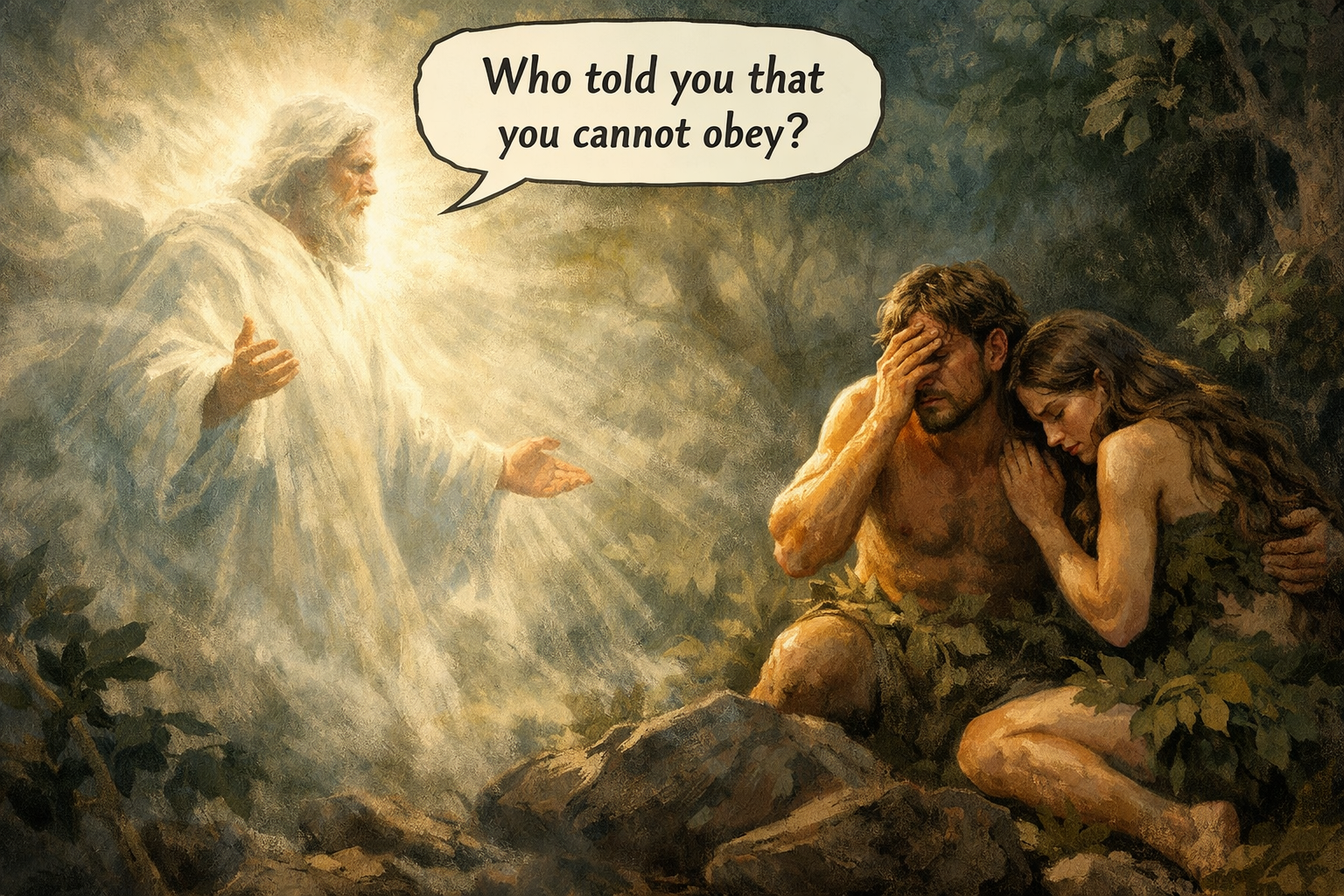
God did not say that.
Christ did not say that.
The Scriptures do not say that.
And yet many speak as though obedience were a tragic impossibility. God commands it, praises it, requires it, rewards it, and judges men for refusing it. Still we are told that no one can actually do it in any meaningful sense.
That is not humility. That is unbelief wearing doctrinal cologne.
To be precise about the claim being contested: this is not sinless perfection, autonomous self-salvation, or righteousness by merit. The question is simpler and sharper. It is whether men and women can truly obey God from the heart in the way Scripture describes — with sincerity, wholeness, covenant faithfulness, real fear of God, and real repentance when they sin. Scripture says they can. It says many did. And the theology that denies this, however piously it speaks of grace, ends by correcting God rather than submitting to Him.
Before Sinai, Real Men Walked With a Real God
Long before Sinai, long before the Levitical code, Scripture gives us a human world divided between corruption and faithfulness.
Genesis 4 says of the days of Enos:
"Then began men to call upon the name of the LORD." — Genesis 4:26
That is not the language of helpless inability. That is the language of men turning toward God.
Of Enoch:
"And Enoch walked with God… three hundred years." — Genesis 5:22
Not for an afternoon. Not in theory. Not as a poetic exaggeration. Three hundred years.
Then of Noah:
"Noah was a just man and perfect in his generations, and Noah walked with God." — Genesis 6:9
Notice the setting. This was not written about Noah in a golden age of righteousness. It was written in the very context where:
"The earth also was corrupt before God, and all flesh had corrupted his way upon the earth." — Genesis 6:11–12
All flesh had corrupted his way. That is individual moral action. They corrupted their way. Scripture does not speak as though human corruption were a tragic accident for which no one is to blame. Men corrupted their way. In that same world, Noah did not. Enoch did not.
Scripture presents corruption as chosen, and walking with God as both real and possible.
Job (who likewise predates Sinai) is called:
"perfect and upright, and one that feared God, and eschewed evil." — Job 1:1
And Abraham is described by God Himself:
"Abraham obeyed my voice, and kept my charge, my commandments, my statutes, and my laws." — Genesis 26:5
That is not thin, sentimental obedience. God Himself piles up the terms: voice, charge, commandments, statutes, laws. Whatever else one does with that verse, one cannot honestly use it to argue that obedience was absent before Sinai.
Obedience was not invented at Sinai. Neither was the possibility of it.
Sinai Did Not Make Obedience Impossible
Some argue that Sinai did not give Israel a path to walk, but an impossible demand — a command not meant to be obeyed, only failed. Did God reveal His law as something to be kept, or as a standard deliberately placed beyond reach?

If that picture looks monstrous, it is because the doctrine it represents is monstrous too.
Scripture says otherwise.
"For this commandment which I command thee this day, it is not hidden from thee, neither is it far off… But the word is very nigh unto thee… that thou mayest do it." — Deuteronomy 30:11–14
And again:
"For this is the love of God, that we keep his commandments: and his commandments are not grievous." — 1 John 5:3
Of Joshua and Caleb:
"they have wholly followed the LORD." — Numbers 32:12
Of David:
"David did that which was right in the eyes of the LORD, and turned not aside from any thing that he commanded him all the days of his life, save only in the matter of Uriah." — 1 Kings 15:5
That one verse dismantles a thousand evasions. David's sin is real, hideous, and named. Scripture does not hide it. But neither does Scripture flatten his whole life into total failure. It identifies the exception precisely because the exception interrupts a pattern, and a pattern can only be interrupted if it first exists.
Biblical obedience is not defined as never once needing mercy. It is defined as walking faithfully before God, and when one sins, repenting under His rebuke rather than hardening in rebellion.
That is why Scripture says of Asa:
"Asa's heart was perfect with the LORD all his days." — 1 Kings 15:14
Of Hezekiah:
"He trusted in the LORD God of Israel… he clave to the LORD, and departed not from following him, but kept his commandments." — 2 Kings 18:5–6
Of Josiah:
"He turned not aside to the right hand or to the left." — 2 Kings 22:2
And again:
"There was no king before him, that turned to the LORD with all his heart, and with all his soul, and with all his might, according to all the law of Moses." — 2 Kings 23:25
With all his heart. Not "partially." Not "as much as a depraved constitution allows." Not "in a merely imputed sense while practical obedience remains impossible."
Scripture says what it says. So who told you that loving God with all your heart cannot actually happen in the life of a human being? Certainly not God.
The New Testament Offers No Escape
If the Old Testament evidence is inconvenient, the New Testament offers no rescue. It continues, without interruption or apology, the same kind of language.
Zacharias and Elisabeth were:
"both righteous before God, walking in all the commandments and ordinances of the Lord blameless." — Luke 1:6
Joseph was "a just man" (Matthew 1:19). Simeon was "just and devout" (Luke 2:25). Of Nathanael, Christ Himself said, "Behold an Israelite indeed, in whom is no guile" (John 1:47). Cornelius was "a devout man, and one that feared God… a just man" (Acts 10:2, 22). Joseph of Arimathea was "a good man, and a just" (Luke 23:50).
Paul says of his own conduct among the Thessalonians:
"how holily and justly and unblameably we behaved ourselves among you." — 1 Thessalonians 2:10
And to believers at Rome:
"ye have obeyed from the heart… being then made free from sin, ye became the servants of righteousness." — Romans 6:17–18
The New Testament does not speak as though grace lowers the moral possibility of obedience. It speaks as though grace produces it.
That is not the language of a gospel that leaves obedience in the realm of fantasy. It is the language of real transformation, real holiness, real righteousness, real obedience from the heart.
The Standard Objections Do Not Settle the Matter
At this point, certain texts are predictably produced. "There is none righteous, no, not one" (Romans 3:10). "All our righteousnesses are as filthy rags" (Isaiah 64:6). Do these not collapse the argument?
They do not — because they are not answering the same question.
Paul's argument in Romans 3 concerns the ground of justification before God. No flesh will be justified by the works of the law — meaning no man earns standing before God by his own record. That is not the claim being made here. The claim is that those who fear God, call upon His name, and walk in His mercy are actually capable of real obedience, real faithfulness, real love. That is not merit. It is fruit. Isaiah 64:6 belongs in the same category: a prophet confessing the nation's collective rebellion — the people who should have been faithful, and were not. It is an indictment of actual unfaithfulness, not a philosophical decree that holiness is impossible for all people in all ages.
Paul himself is the clearest evidence that these truths coexist without contradiction. He does not use Romans 3 to prevent him from writing in 1 Thessalonians 2:10 that he and his companions "holily and justly and unblameably" conducted themselves. He does not treat free justification as incompatible with Romans 6:17. The two truths stand together in his own letters. They should stand together in our theology.
"Blameless" Means Something Real
The predictable move when pressed by these texts is to evacuate the vocabulary. Call a man "blameless," and the apologist for inability will explain that the word must mean something safely diluted — not an actual description of life before God, only a softened label that leaves the doctrine untouched.
This is doctrinal taxidermy: the word is stuffed and mounted, preserved in its outward form while everything living inside it is removed.
Scripture's language does not cooperate with this procedure. "Perfect," "upright," "blameless," and "wholehearted" describe a genuine orientation of life before God — sincere faith, real obedience, integrity, the fear of God, and repentance when reproved. They do not describe sinless autonomy. They do not describe self-salvation. But they are not decorative either.
God says "wholehearted," and man says "not really." God says "blameless," and man says "only in a way that empties the word of ordinary meaning." God says "perfect," and man says, "Yes, but not in any sense that would threaten my doctrine."
That is not exegesis. It is correction. And the one being corrected is God.
Faith Versus Excuse
Let the record be plain:
This is not works-salvation. This is not salvation by merit. This is not legalism. This is not boasting in the flesh.
Obedience is not the root of salvation. It is its fruit.
This is how the excuse works. God commands obedience. Man shrinks back. Theology then arrives to reassure him that his retreat was wisdom. Disobedience is renamed realism. Unbelief is renamed humility. Grace, which Scripture presents as power for holiness, is reduced to a doctrine for making peace with failure. Men are taught to admire commandments they do not expect to keep and to call that posture spiritual maturity.
A doctrine becomes dangerous when it trains men to feel orthodox precisely where Scripture would have them repent. Calling obedience impossible does not magnify grace. It protects disobedience from embarrassment.
The Bible is not embarrassed by obedience. Why are so many preachers?
Who Told You That You Cannot Love God With All Your Heart?
Somewhere along the line, many Christians were taught that the safest way to sound spiritual is to deny the plain force of God's commands and the plain meaning of God's praise — to speak as though every commandment exists mainly to prove our inability, and every description of obedience must be qualified until it means almost nothing.
But the Lord's question breaks through:
Who told thee that thou wast naked?
Who told you that you cannot obey God with your whole heart?
Who told you that wholehearted love for God is impossible?
Who told you that walking with God is futile?
Who told you that the safest response to God's commands is preemptive surrender to disobedience?
Not God.
Consider what Scripture actually says:
It says Enoch walked with God.
It says Noah was just and perfect.
It says Job was perfect and upright.
It says Abraham obeyed God's voice, commandments, statutes, and laws.
It says Joshua and Caleb wholly followed the Lord.
It says David turned not aside, except in the matter of Uriah.
It says Asa's heart was perfect.
It says Hezekiah departed not from following Him.
It says Josiah turned with all his heart.
It says Zacharias and Elisabeth were blameless.
It says believers obey from the heart.
The serpent's oldest move was not open atheism. It was teaching man to distrust what God had plainly said — to believe that what God described, He could not really have meant.
God says, "walk before me." God says, "fear me." God says, "keep my commandments." God says, "turn unto me with all your heart." God says, "be ye holy." God says, "follow me."
When God calls a man upright, say, "Yes, Lord."
When God calls a woman blameless, say, "Yes, Lord."
When God says one obeyed from the heart, say, "Yes, Lord."
When God commands you to love Him with all your heart, do not answer with the serpent's theology of impossibility.
The lie is not that God's standard is too high.
The lie is that obedience is impossible — and that saying so is the same thing as honoring grace. It never was.
And the excuse grows thinner, not thicker, as redemptive history moves forward.
And if this was true before the New Covenant, before grace was revealed in its fullness in Christ, before the Spirit was poured out upon the people of God — what excuse remains for those who stand on this side of Pentecost?
If they walked with God in dawnlight, what shall we say of those who refuse Him at noon?
Indeed, How Can We Not Obey?