Turning God's Gift into Contraband
Jesus wasn't just some rebel.
He was a rebel against counterfeit holiness.
And God has a habit of confronting counterfeit religion with targeted judgment. Egypt learned that the hard way. The plagues weren’t random fireworks; they read like precision strikes against a whole religious system. Whether you map each plague to a named deity or simply to Egypt’s worldview, the message is the same: God does not share His authority with religious machinery.
When Jesus arrives, He carries that same signature. His “signs” aren’t merely displays of power. They’re confrontations—judgments against man-made systems that add commandments to God’s commands and then call the result “holiness.”
God gave His commandments. The Pharisees built a "safety system" around those commands—extra rules meant to prevent rule-breaking—and then treated their safety system as the command itself.
That's the move.
That's the spiritual sleight-of-hand.
The Pattern Jesus Exposed
God gives a command.
Man builds a fence.
Man crowns the fence.
Then man starts measuring righteousness by proximity to the fence, not actual obedience to God.
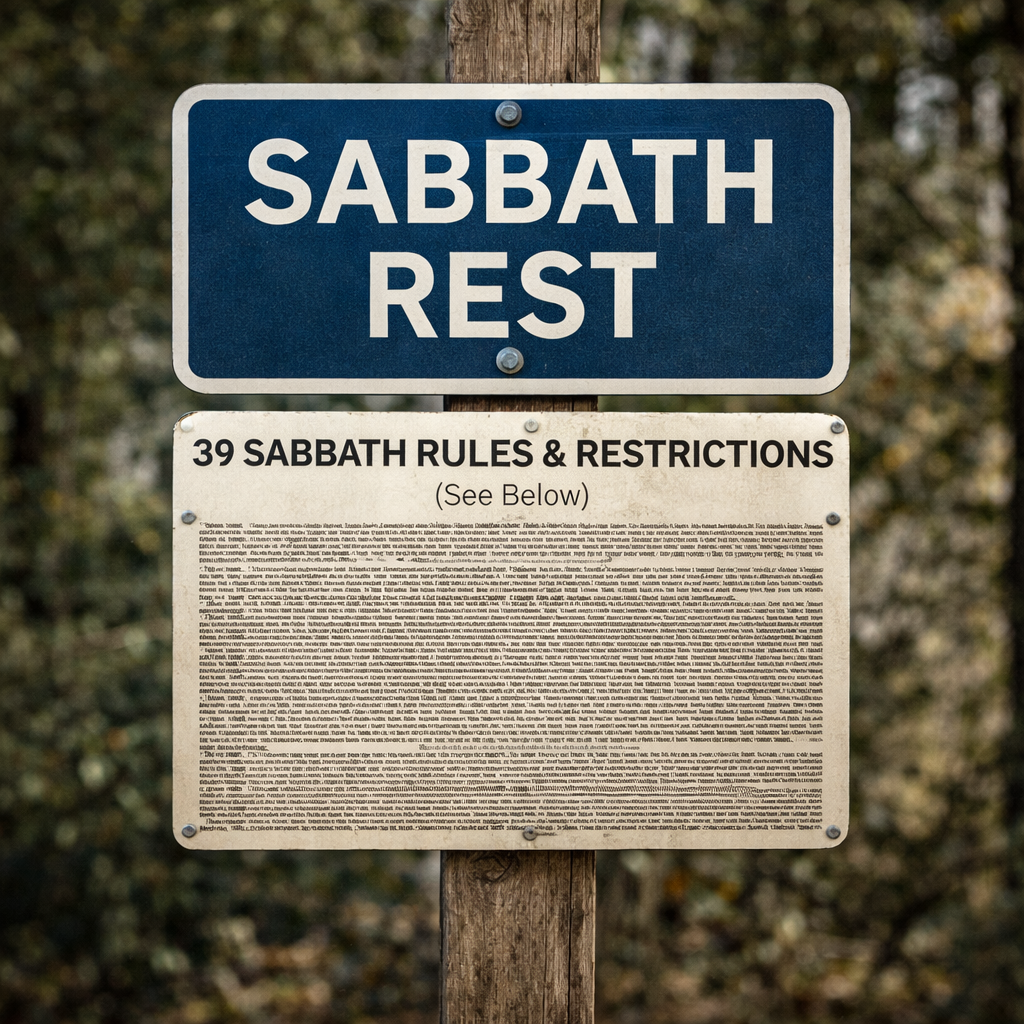
God commanded them not to work on the Sabbath, and man added 39 layers of forbidden "work" so that you could be sure never to violate the Sabbath.
Sounds reasonable, right?
And familiar.
The problem is that we say, "Look how careful we are with God's Word" while quietly doing the one thing God most condemns: adding to His Word and binding consciences with it (Mark 7:8–13; Matthew 15:3–9).
Jesus broke many of their 39 guard rails around the Sabbath. He never once broke the Sabbath. He violated their caution without breaking God's command.
And the religious leaders responded exactly like they always respond when their version of righteousness gets threatened: they slandered Him.
- "Glutton."
- "Winebibber."
- "Friend of sinners."
- "Sabbath-breaker."
None of those accusations were true in the way they meant them (Luke 7:33–34). But that didn't matter. A rigged court doesn't need evidence; it just hides behind eloquence.
Of course, not every boundary is born of legalism. Some abstentions are driven by love, conscience, or cultural witness—which the New Testament itself honors. But when personal conviction hardens into law, and when personal wisdom becomes public condemnation, we've crossed a line.
A sign that shows the pattern (without breaking the Law)
John quietly tells you why the Cana sign would have felt outrageous: those jars weren’t just containers—they were “for the Jewish rites of purification” (John 2:6). In other words, they were part of a holiness system—religion’s plumbing. And Jesus doesn’t smash it or mock it; He simply takes control of it. He has the servants fill the purification jars to the brim, and the water becomes wine. That’s not a party trick; it’s a confrontation: the apparatus they used to manage “clean” and “unclean” gets repurposed into a gift, without permission from the purity police. Jesus isn’t breaking God’s law—He’s breaking the illusion that tradition’s machinery is the doorway to holiness.
And that’s the recurring motif: healing on the Sabbath without violating it, touching the unclean and making them clean, reaching into death and pulling life back out—each time exposing the same thing. God’s commands versus man’s control-systems.
How We Rebuild the Same Trap
Allow me to illustrate a modern version of that trap.
God says:
Wine is a good gift that can function as blessing, joyful worship, offering, and ordinary gladness (Psalm 104:14–15; Deuteronomy 14:23–26; John 2; Matthew 26:27–29).
God also says:
Drunkenness is sin—destructive, enslaving, disqualifying (Proverbs 23:29–35; Ephesians 5:18; 1 Corinthians 6:9–10).
And here's the kicker:
Scripture speaks positively about wine almost twice as often as it warns against its misuse—yet you'd never guess that from the average sermon.
(Here's a rare exception.)
The modern teaching on wine often sounds like a legal disclaimer drafted out of fear. And that fear isn't unfounded. But the point is that we don't teach the whole text; we curate it. We add our own guardrails and teach those like they're scripture.
We don't let Scripture set its own proportions; we rebalance it until the warning label makes headlines and the worship label becomes an embarrassing footnote—if mentioned at all.
We take a gift God openly puts on the table and we treat it like contraband.
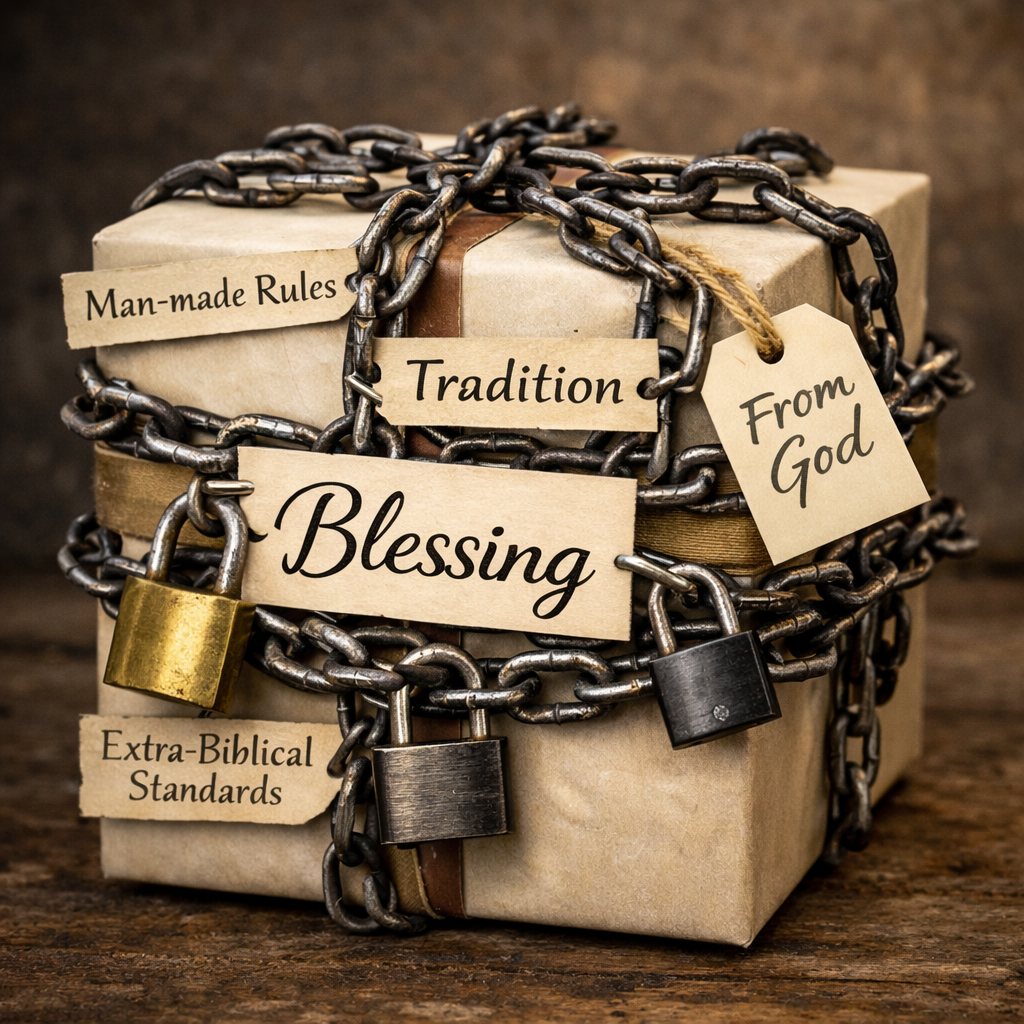
We dodge the real sin—drunkenness—by demonizing the object, not discipling the person.
The problem isn't discernment or personal conviction—it's when caution becomes condemnation and gifts become guilt trips.
So the congregation learns a counterfeit math:
that holiness means subtracting what God has permitted, and wisdom means distrusting what God called "good."
God said don't work on the Sabbath, and the Pharisees added a guardrail that made dragging a chair equal to plowing the ground. (That's not an exaggeration: they really enforced this.)
The result is predictable and devastating: a Bible that still sits open, while its voice gets edited down to a single note—warning—until the full song of blessing becomes inaudible.
So what do we do?
We take a clear sin (drunkenness) and replace it with a more controllable badge (abstinence).
Then we call the badge "holiness."
That's not sanctification.
That's brand management.
It's the same "fence-crowning" logic:
- God forbids drunkenness.
We forbid wine. - God calls for self-control.
We call for complete avoidance. - God says don't be mastered by anything.
We say, "Don't even touch it," as if holiness is fragile.
And then: we end up calling evil what God calls good, and calling "wisdom" what God calls "teaching as doctrines the commandments of men."
That isn't extra holy. That's Mark 7 Christianity wearing a "conservative" smile.
You Don't Just Add Rules — You Neuter Effect
When you turn God's gift into contraband, you have to do violence to the text to keep your system intact.
So you start doing things like:
-
Treating "abstain from all appearance of evil" (1 Thessalonians 5:22) as if it means "avoid anything someone might misjudge," instead of what it actually means in context: avoid every form/kind of evil. Wine isn't evil—abusing it is. The line was already drawn. We just moved it.
-
Flattening Romans 14 into "the strong must become teetotalers," instead of what it actually teaches: don't despise, don't judge, don't pressure consciences; pursue love and peace.
-
Quietly ignoring that Scripture explicitly warns against forbidding what God created to be received with thanksgiving (1 Timothy 4:1–5).
Read that last one again.
God gave meat to be enjoyed. Some turn around and forbid it. God calls that a doctrine of devils. And yes — Scripture says, "It is good not to eat meat or drink wine or do anything that causes your brother to stumble" (Romans 14:21).
That's real.
That's love.
That's maturity.
But notice what Paul is doing: he's calling for personal sacrifice, not public bans. He doesn't turn his restraint into a church-wide law.
We do.
He aims it at protecting people, not policing consciences.
This is the devastating irony: in the name of "protecting God's Word," we make it "of none effect."
We don't just forbid drunkenness.
We forbid the entire category of a "gift" God openly gives.
Don't miss the point:
this is not about wine or meat.
This is about training people to believe the Bible is safe only after it passes through our tradition-filter. That is how you create a culture that can quote verses and still doesn't trust the text.
The Real Issue: Conscience Control
"Pharisaism" isn't merely rule-making.
It's conscience-seizing.
It says:
- "God didn't explicitly forbid this, but we do… and if you disagree, you're rebellious."
- "You're not allowed to be free where God has left you free."
- "Our tradition is the measuring stick for your spirituality."
That's why Jesus hits it so hard: not because fences are always malicious, but because fences so easily become chains, and chains are a rival law.
How to Tell If You've Crowned a Fence
You're not just being "careful" anymore when:
- You label people as compromised for using what Scripture calls a gift.
- You make your preferred boundary the proof of righteousness.
- You call moderation "toeing the line" instead of calling drunkenness the actual sin.
- You can't teach the full Bible on the subject without apologizing for it or adding lots of footnotes.
- Your "holiness" produces pride, suspicion, and a culture of accusation rather than love, joy, peace, and self-control (Galatians 5:22–23).
Truth Without Chains, Freedom Without License
Jesus doesn't produce lawless people.
He produces people who obey from the inside out.
The biblical posture is not:
- "Wine is sin"
(Scripture won't let you say that),
and it is not: - "Drunkenness is no big deal"
(Scripture won't let you say that either).
It's this:
- Wine can be received with thanksgiving.
- Drunkenness is sin.
- Love refuses to pressure a weaker conscience.
- Freedom refuses to submit to man-made chains.
- Self-control is the actual target, not virtue-signaling or abstinence.
Abstinence is fine. Preferable for many. Permitted by scripture.
But the irony? Those most obsessed with their liberty to abstain are usually the first to shame others for having the liberty to enjoy.
That’s exactly what the Pharisees did: turned rest into a burden, then judged anyone who dared to enjoy what God commanded.
Don't Miss the Point
This is not about wine or meat; that's just an easy example to show the parallel. Ignore those specifics, if you must, so long as you understand what’s behind them:
The Pharisees didn’t hate Jesus for breaking God’s Sabbath.
They hated Him for breaking their illusion of personal holiness.
And we repeat their sin every time we take a clear biblical gift, slap a "worldly" label on it, and judge the faithful as compromised for receiving what God created for them. We congratulate ourselves for being "careful," while we quietly call God's generosity suspicious and His Word insufficient.
God's gifts don't need your guilt. Handle them with humility, not handcuffs.