Crucifixion Timeline
Why the Crucifixion Timeline Only Looks Contradictory
The crucifixion accounts look tangled because we quietly switched calendars. Most "Good Friday" timelines import modern assumptions into an ancient world that did not share them, then blame the text when the numbers stop working. Most of the alleged contradictions do not need to be explained away. They need to be read in context, with Jesus' own words allowed to govern the timeline.
Most people who study Passion Week hit the same wall. The Gospels can seem to clash. Jesus says "three days and three nights," yet Friday to Sunday barely gives you two. "Preparation Day" gets treated like a fixed label for Friday. John seems to place the Passover differently from the other Gospels.
The usual move is familiar: call the language idiomatic, shrug at the tension, and move on.
But what if the problem is not the Gospels? What if we have been reading a first-century Jewish text through a modern Western calendar, then calling the text fuzzy when our assumptions fail?
This essay is trying to do something simpler and more honest. It does not pretend every difficulty disappears. Some real pressure remains. But many of the alleged contradictions soften considerably once the texts are read inside their own feast structure, Sabbath categories, and timekeeping rather than ours. More than that, the closer those assumptions are examined, the more the traditional Friday framework begins to look less like the plain reading and more like a habit inherited so long ago that many readers no longer notice they are defending it.
The Eight Mistakes That Create the "Contradiction"
Before fixing the problem, name it clearly. Most crucifixion-timeline disputes grow out of one or more of these:
-
Treating "Preparation Day" as if it simply means Friday.
In context, it means the day before a Sabbath or feast. That can fall on different weekdays. -
Ignoring High Sabbaths.
Not every "Sabbath" in the Passion narratives is automatically the regular weekly Sabbath. -
Flattening "Passover" into one meal.
The term can refer to the lamb-night, the Feast of Unleavened Bread, or the whole festival block. -
Forcing "day" to mean the same thing every time.
Feast observance followed one reckoning. Roman administration followed another. Narrative description could still speak from lived daytime experience. These are not the same. -
Importing midnight-to-midnight assumptions into Jewish feast texts.
Roman timekeeping is not what governs Passover. -
Hand-waving "three days and three nights."
Jesus' wording gets loosened to protect the Friday timeline instead of being allowed to constrain it. -
Assuming the resurrection happened at sunrise.
The text says the tomb was empty by dawn, not that Jesus rose at that exact moment. -
Cherry-picking Gospel phrases.
Readers lean on "on the third day" while sidelining "after three days," or vice versa, instead of finding the reading that lets both stand.
Correct those assumptions, and the supposed contradictions already look less dramatic. Press them further, and the ground under the usual timeline begins to give way.
Different Reference Frames for Time
This is the part most discussions skip, and without it, everything else turns to guesswork.
There is more than one way to reckon a "day" in the world of the New Testament. The critical move is distinguishing formal calendar reckoning from ordinary narrative description.
The Jewish Feast Calendar: Evening to Evening
Holy days, Sabbaths, and feasts were formally reckoned from evening to evening.
That is not speculation. It is legislated. Leviticus 23:32 says it plainly for the Day of Atonement: "from evening to evening." The weekly Sabbath follows the same pattern. So do the feast days.
This is the reckoning that governs Passover, Unleavened Bread, and the sacred days surrounding the crucifixion.
Narrative Description vs. Formal Reckoning
That evening boundary does not stop people from speaking about their day in ordinary terms. People wake up, work, travel, transact business, go to the temple, and describe the day from that lived experience.
We still do this ourselves. Our calendar runs midnight to midnight, but almost no one says "my day started at midnight." We speak as if the day starts in the morning, and no one calls that a contradiction.
The same applies in first-century Jewish narration. Formal feast reckoning runs evening to evening. Narrative can still speak from the standpoint of waking life. This is normal usage, not inconsistency.
The Roman Civil Day: Midnight to Midnight
Roman administration and legal procedure used the midnight-to-midnight system that later shaped Western timekeeping, and most modern readers unconsciously import that framework into texts that are not operating by it.
Why This Matters
These reference frames overlap, but they do not line up. One evening can belong to the close of ordinary daytime activity, the opening of the next feast day, and the middle of a Roman civil day all at once.
Collapse all of that into one flat modern notion of "day," and contradictions appear that exist only in your assumptions.
The Feast Structure: What Passover Week Actually Contained
One of the biggest sources of confusion is this: Passover and the Feast of Unleavened Bread are distinct events. They are related, tightly joined, and often spoken of together. But they are not identical.
Passover: The 14th
Exodus 12:6 says the lamb was to be slain "between the two evenings" (Hebrew: ben ha-arbayim). That phrase has been debated for a long time, and this essay does not need to resolve every detail of that debate. But one plausible reading within an evening-to-evening feast framework places the slaying at the twilight that opens the 14th, the sunset boundary at which the 14th begins.
If that reading is right, the sequence runs like this:
- The lamb is slain at the start of the 14th.
- It is eaten during that night, still on the 14th by feast reckoning.
- Nothing is to remain until morning.
- The destroying angel passes at midnight; Pharaoh summons Moses "by night," all within the 14th.
- Then Numbers 33:3 anchors what follows: Israel departed on the 15th, "on the morrow after the Passover."
That last verse matters enormously. Passover night and national departure are not the same moment. The 14th begins the exodus. The 15th completes it publicly. Under this reading, the two-day pattern is not a problem. It is built into the feast structure itself.
Passover uses unleavened bread, yes. But it is still its own day, distinct from the seven-day feast that follows.
Feast of Unleavened Bread: The 15th Through the 21st
This feast begins the day after Passover. Its first and seventh days are sacred rest days, functioning as Sabbaths regardless of what day of the week they fall on.
Eight Days of Unleavened Bread Total
Unleavened bread is eaten on Passover and throughout the seven-day feast: eight days total. Scripture still distinguishes Passover from the Feast of Unleavened Bread. Blurring them into one generic idea creates confusion quickly.
"Sabbath" Does Not Always Mean Saturday
This is one of the most important corrections in the whole discussion.
Many readers hear "Sabbath" and instantly think Saturday, full stop. But Scripture uses Sabbath language more broadly. The weekly Sabbath is the seventh day of the week. Feast-day Sabbaths are sacred rest days fixed by festival dates, not by the weekday cycle.
So not every Sabbath reference in the Passion narratives should be read as "Saturday by definition." That single correction clears more confusion than almost anything else.
The High Sabbath in John 19:31
John does not simply say "Sabbath." He says the coming Sabbath was a "high" or "great" day.
That signals festal significance. It tells the reader not to flatten this into a routine weekly Sabbath and move on.
Because feast Sabbaths are date-based and the weekly Sabbath is cycle-based, one week can contain both. John 19:31 does not prove that happened in the Passion week beyond all dispute, but it keeps the possibility open and warns against premature simplification. And once that possibility is admitted, the usual timeline is no longer the obvious default it is often assumed to be.
A Case Study from Exodus: Two True Statements, One Event
Exodus itself gives the pattern that helps make sense of the Gospels.
During the night of the 14th, the destroying angel passes through Egypt. Pharaoh orders Israel to leave. Families gather their things and begin moving.
During the day of the 15th, Israel goes out of Egypt as a people.
Both statements are true:
- Israel began going out on the night of the 14th.
- Israel went out of Egypt on the 15th.
No contradiction exists unless you force both statements to describe the exact same instant. An action can begin in one sacred time frame and be publicly completed in the next. That pattern becomes directly relevant when the Passion narratives are read against the same feast calendar.
The Last Supper and John's Passover Language
This is one of the sharpest pressure points in the whole discussion and deserves its own treatment.
What the Synoptics Say
Matthew, Mark, and Luke are straightforward: the disciples prepare the Passover, Jesus reclines at table, and he identifies the meal himself. Before any commentator harmonizes anything, Jesus calls it Passover.
Luke records the clearest line of all:
"I have earnestly desired to eat this Passover with you before I suffer."
The meal also bears several Passover features: Luke records a two-cup structure, John records a dipped morsel given to Judas, and Matthew and Mark record a closing hymn, almost certainly the Hallel Psalms traditionally sung at Passover's close. None of those details proves the whole case by itself. Together they make a Passover setting the most natural reading of the meal.
What John Says
John uses Passover language around the crucifixion in ways that create real chronological pressure. He says the supper happened "before the feast of the Passover." He says the leaders avoided defilement so they could still "eat the Passover." John 19:14 speaks of "the preparation of the Passover."
That tension is real and should not be dodged. John 19:14 is probably the sharpest chronological pressure point in the entire Passion narrative. Some commentators read it as placing the crucifixion precisely at the hour the Passover lambs were being slaughtered in the Temple, a reading with genuine theological weight.
But there is a fact that changes the shape of the problem: in first-century Jewish usage, "Passover" could refer narrowly to the lamb-night or broadly to the surrounding festival period. Josephus, writing in the same century, uses the term both ways, sometimes in the same work.
That means John can naturally be read as using wider feast vocabulary. He need not be denying that Jesus ate the Passover with his disciples. He may be framing the crucifixion within the broader festival setting.
John 13 supports this. When the disciples assume Judas is going out to buy things "for the feast," the point is not that the lamb-meal still lies ahead. It is that the festival period is ongoing. There is more observance to come.
The tension remains, but it becomes more manageable. John is not obviously describing some entirely different meal. He can be read as viewing the same events through a broader festal lens and a distinct theological emphasis.
"Preparation Day" Does Not Settle the Chronology by Itself
The phrase carries more interpretive weight than it can actually hold.
It is not a fixed synonym for Friday in every context. At root, it names the day of preparation before a Sabbath or sacred day. Yes, it can refer to Friday; Mark 15:42 makes that plain for weekly usage. But the phrase alone does not settle the Passion chronology. It tells you a Sabbath is coming. It does not tell you which one.
In John's account especially, "Preparation Day" sits inside Passover and festal context. Identifying which Sabbath follows requires reading that context, not stopping at the word itself and assuming Saturday.
If a given week contains both a High Sabbath and the regular weekly Sabbath, more than one preparation day is possible.
Why the Priests Could Still Act
This also explains why the priests are active on a day tied to feast concerns. By formal feast reckoning, the sacred day had not yet begun. Sundown had not arrived. They were still in the daylight hours before the feast boundary turned.
That is not special pleading. It is simply how the calendar worked.
"Three Days and Three Nights": Let the Words Stand
Here is Jesus' statement:
"For as Jonah was three days and three nights in the belly of the great fish, so will the Son of Man be three days and three nights in the heart of the earth."
— Matthew 12:40
This is one of the clearest anchors in the entire chronological discussion, and it deserves to carry real interpretive weight, not be softened to protect a tradition. The burden falls on any timeline that cannot naturally account for the nights as well as the days.
The timeline should bend to Christ's words before Christ's words bend to the timeline.
What Inclusive Reckoning Can Do
Inclusive reckoning is a real and documented feature of ancient Jewish counting, and it deserves fair treatment.
The convention treats any portion of a period as the whole for certain expressions. That explains how Friday, Saturday, and Sunday can be described as "the third day." It also handles phrases like "after three days," "in three days," and "on the third day." That part of the argument is legitimate and worth conceding.
What Inclusive Reckoning Cannot Naturally Do
It does not naturally solve the night-count.
A Friday-afternoon crucifixion and a pre-dawn Sunday resurrection still give you only two nights: Friday night and Saturday night. To rescue the Friday timeline, the nights would have to become as elastic as the days. But that is precisely what Jesus' wording resists. He did not merely say "three days." He gave the Jonah sign: "three days and three nights."
The nights are not decoration. They are part of the sign itself. Jonah 1:17 uses the same formulation, and that is the parallel Jesus deliberately chose. Once you treat the nights as expendable, you have already made his words say less than they say.
The Conclusion That Follows
Inclusive reckoning may explain the day-count language. It does not naturally explain the full Jonah formulation.
The stronger reading is therefore not the one that loosens Jesus' wording to preserve tradition. It is the one that lets his wording stand and then reexamines the timeline accordingly.
That does not prove an exact weekday, and this essay does not pretend otherwise. What it claims is simpler and stronger: the surrounding feast structure, Sabbath distinctions, Passover usage, and resurrection timing remove the obstacles that have kept Jesus' own words from being heard on their own terms. And once those obstacles are removed, the older Friday framework no longer looks like the most faithful reading. It looks like the reading least willing to let Jesus' own sign speak with its full force.
The goal is not to force certainty where Scripture has not given it. It is to refuse to make Jesus say less than he said.
The Gospels Tell the Same Story, Just Not in the Same Way
Much of the apparent contradiction dissolves once you remember how normal storytelling works.
Writers give overview, then detail. They summarize, then circle back. They emphasize different moments. They use different reference points. That is not error. It is ordinary narration.
Think of four friends describing the same road trip. One mentions the storm in passing. Another spends twenty minutes on it. Neither account is false. They are simply not organized the same way.
The Gospels work like that too. They agree on the sequence that matters: Last Supper, betrayal, trials, crucifixion, burial, resurrection, appearances. Where they differ is in what they foreground and how they arrange supporting details.
Phrases like "after three days" and "on the third day" can coexist without contradiction. Ancient reckoning could speak of the same event from slightly different counting perspectives. But that does not touch the force of Jesus' explicit night-count in Matthew 12:40. Those are separate questions.
Luke's orderly account is orderly on Luke's own terms, not a global override of the other Gospels' orderings. John's theological framing shapes John's presentation throughout. None of that is a problem unless we demand modern newspaper chronology from ancient theological narratives.
The right question is not "Which Gospel do I trust?" It is "What reading lets all of them stand?"
The Resurrection: Empty by Dawn, Not at Dawn
One more assumption needs to go.
The text does not say Jesus rose at sunrise Sunday morning. It says the women arrived very early and found the tomb already empty, while it was still dark (John 20:1) or at first light. The angels do not say "He is rising right now." They say "He is not here; He is risen."
If the resurrection occurred before dawn, potentially hours before the women arrived, then "must be Sunday at sunrise" is a tradition imposed on the text, not something the text requires. That removes yet another artificial constraint from the timeline.
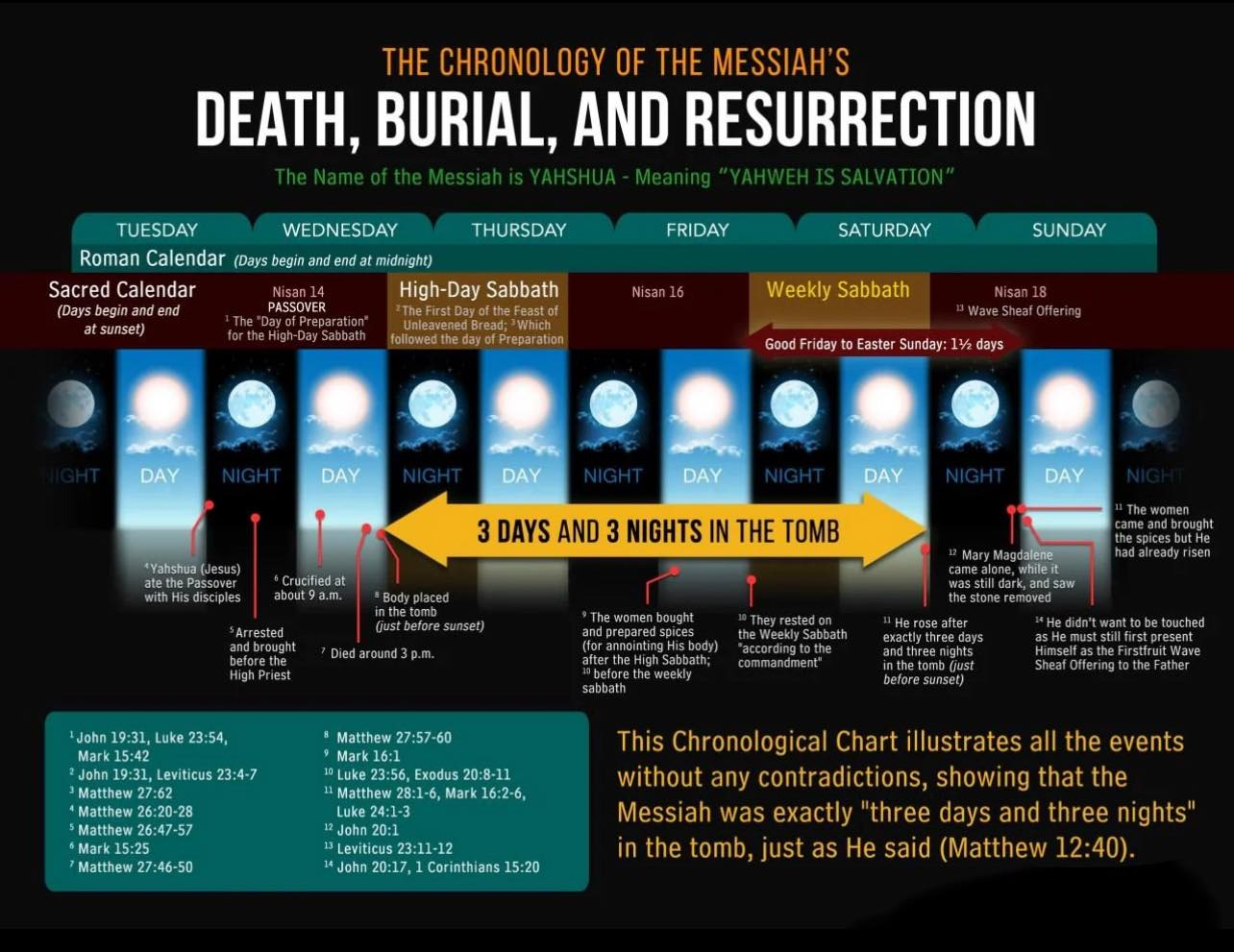
The chart reflects the same basic reconstruction argued in this essay, especially the conviction that Jesus’ “three days and three nights” should be taken at full weight. A visual timeline naturally states some points more sharply than the essay does, but the structure is the same and helps show why this reading fits the scriptural data better than the flattened Friday-to-Sunday model.
What This Is Really About
This is more than a calendar puzzle.
The feast structure, the Sabbath distinctions, and the Passover pattern are not random religious scaffolding. They are the framework the Gospel writers assume while presenting Christ as the true Passover. The same structure that complicates modern timelines is the structure that makes the theology cohere.
Jesus' blood is shed with both Jewish and Roman involvement. That is not incidental. Jew and Gentile alike stand guilty. Jew and Gentile alike are within the scope of the atonement. The same complexity that makes the timeline harder to sort out is the complexity that makes the meaning fit.
When you let the text stand on its own terms, the symbolism gets cleaner, not murkier.
A Larger Reading Principle
This timeline question is only one example of a larger interpretive problem. Many alleged contradictions in Scripture are not created by the text first, but by the assumptions readers bring to it: flattened categories, forced definitions, modern expectations, and inherited systems that begin controlling the passage before the passage is allowed to speak. I lay that out more fully in A Better Way to Approach Contradictions. What matters here is simply this: the same reading habits apply in the Passion timeline. Terms like Preparation Day, Passover, Sabbath, and even Jesus' own "three days and three nights" must be allowed to stand at full strength before they are pressed into a familiar framework.
This study was deeply shaped by the faithful work of Norm Sharp, whose willingness to search the Scriptures carefully, and to uphold their authority even in difficult passages, was a tremendous help.