Character vs. Reputation—and the Cruel Economy of Other People's Opinions
There are two versions of you walking around in the world.
One is real.
The other is public.
Character is who you are when nobody's watching, when the room is quiet, when the temptation is loud, and the only "audience" is God and your own conscience.
Reputation is who people think you are—stitched together from partial data, overheard fragments, vibes, and whatever story the crowd finds easiest to digest.
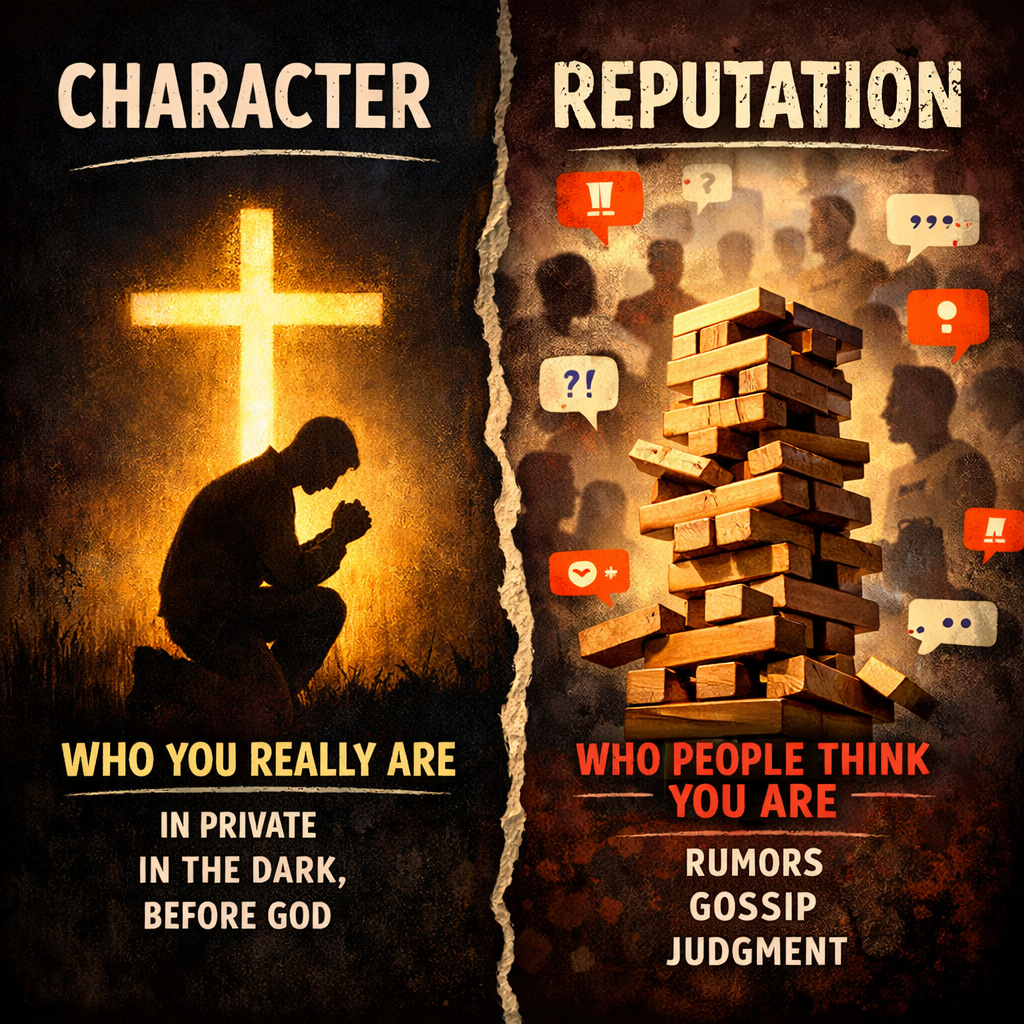
Character is fact.
Reputation is… an algorithm with feelings—a cute way of saying: "chaos, but with confidence."
And if you've ever had your name dragged, misunderstood, whispered about, or used as a prop in someone else's narrative—then you already know this: reputation is a fragile thing to build your peace on. Reputation is a Jenga tower in a chaotic daycare: eventually a toddler screams, everything falls, and nobody admits touching it.
A few years ago, something happened that threatened my reputation among some business people in my town. It was outside my control. And it bothered me—deeply.
Not because I suddenly became a villain in my own eyes, but because I felt the ground shift under my feet: the unsettling realization that other people can rewrite you without your permission, then call it "discernment." They can take a snapshot and call it a biography. They can take a lie and call it "just asking questions." Their new favorite hobby becomes moral karaoke—singing righteousness to the tune of your misery.
I worried myself into stress ulcers. That's not a metaphor. I had turned other people's opinions into an idol. My stomach filed a formal complaint.
That's what reputational fear does: it doesn't just bruise your feelings. It colonizes your body. It moves into your nervous system like an unwelcome tenant and starts redecorating.
During that season, a pastor told me something that has outlived the crisis:
"God does not care about your reputation as much as He cares about the content of your character."
It landed like a mercy grenade.
Because here's the thing nobody wants to admit: reputation has become a kind of currency—and the exchange rate varies based on who’s mad and who has a group chat. In business. In church. In families. In friend groups. In social media. We trade it, protect it, hoard it, and panic when the market dips.
We live in a world where "image management" is treated like wisdom, and "perception" is treated like reality. This often leaves us just one screenshot away from becoming the villain in someone's redemption arc. Entire industries exist to curate what people think—and if you don't have a staff, a PR plan, and a perfectly timed statement with just the right amount of "accountability," you're expected to just… bleed quietly.
That's not neutral. That's a system.
And systems have incentives. The incentive is simple: control the story, control the people.
A rumor spreads because it's entertaining. A scandal sticks because it makes the listener feel righteous. A slander gains traction because it gives the crowd a villain and gives the storyteller power.
And if you're the one being talked about, the system offers you a cruel bargain:
"Perform for us, and we'll stop punishing you."
Prove yourself.
Explain yourself.
Defend yourself.
Put out fires you didn't start.
And they don't want an explanation.
They want submission.
You can do that for years and still find out the hard way: you cannot out-communicate someone else's hunger to misunderstand you.
Jesus: the ultimate "bad reputation" case study
Jesus has a name above all names—yet He made Himself of no reputation.
That is not a footnote. That is a strategy of love.
He moved toward the broken, the messy, the morally complicated, the socially suspicious—and in doing so, He picked up a reputation among the religious elite that was basically: "This guy is a problem."
They called Him a drunkard. A friend of sinners. A blasphemer. A lawbreaker.
Some called Him nothing at all—just another nobody from a nowhere town: "Does anything good come out of Galilee?"
But His character was a fact to be reckoned with.
And that's the scandal: the most holy man who ever lived had a reputation problem.
So if you're suffering because you've been misunderstood, smeared, reduced, mislabeled, or casually villainized—hear this clearly:
It is possible to be deeply faithful and publicly misrepresented at the same time.
It is possible to be innocent and still not be believed by everyone.
It is possible to be walking in integrity and still become the topic of someone else's entertainment.
"A good name" isn't a fragile idol
Scripture says a good name is worth choosing. But that doesn't mean "protect a fragile reputation at all costs." It doesn't mean "make the crowd approve of you." It doesn't mean "live like a hostage to public opinion."
It means: be the kind of person whose life is anchored in integrity.
Before God.
In private.
In the dark.
In the inconvenient.
When the reward is delayed.
When the applause is absent.
Because reputation can be destroyed with a lie.
Character can be destroyed only by betrayal—yours.
Reputation can be stolen.
Character has to be surrendered.
And the fear of man is a snare precisely because it turns your soul into a performer. It makes you manage perceptions instead of pursuing truth. It makes you negotiate with shadows.
So don't live in fear of someone who might damage your name with a slanderous lie.
(Also: let's be honest—if someone is committed to misunderstanding you, they could misread a children's book and still blame the author. You can't build peace on a moving target. That's like trying to install drywall during an earthquake.)
Instead, live in confidence that you are in Christ, and that in Him you have been made righteous—not by public consensus, not by social approval, not by a flawless reputation, but by His finished work.
Do right.
Tell the truth.
Walk clean.
Repent quickly when you sin.
Make restitution where you must.
And then—this is the hard part—release the rumor mill to God.
Because the court of public opinion is not the throne of the universe.
And you don't need to be universally understood to be fully loved.
The comfort for the hurting
If you're hurting because your name has been dragged, here's what I want to hand you like a blanket and a sword at the same time:
- You are not what they said.
- You are not what they assumed.
- You are not the worst interpretation of your hardest moment.
- You are not obligated to let slander become your identity.
- You are not required to spend your life auditioning for mercy.
God sees in full.
God judges in truth.
God heals what reputational violence tries to fracture.
And sometimes the most "holy" thing you can do is stop trying to control what you cannot control—and start being faithful where you actually have agency:
Your choices.
Your integrity.
Your repentance.
Your love.
Your obedience.
The world can spread stories.
God writes records.
And in the end, the only reputation that will matter is the one you never had to manufacture: the testimony of a life shaped by truth.
God is not confused about you.
And He is not moved by the rumors.
"Do right. If the stars fall from heaven, do right."
— Bob Jones, Sr.